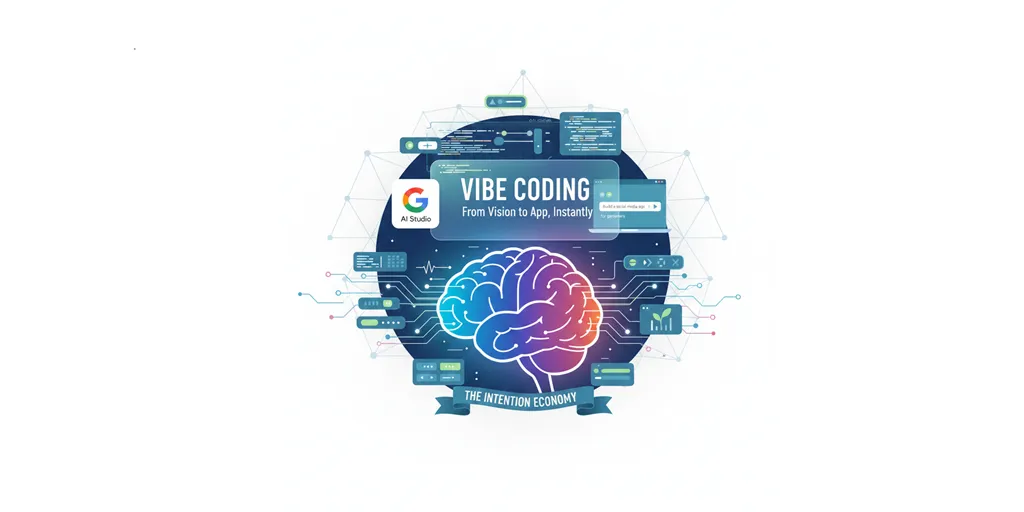
Vibe Coding: The Paradigm Shift That Puts Your Vision, Not Syntax, at the Center of Software Development
Published on December 14, 2025
I. Introduction:
The Death of BoilerplateFor decades, the journey from a brilliant product idea to a functional piece of software has been hindered by a significant bottleneck: boilerplate code and complex syntax. Engineers have spent countless hours writing repetitive, foundational code for UIs, API integrations, and simple data handling—tasks that require precision but offer little creative value.
This is where Vibe Coding enters the picture. Coined in part by industry leaders, Vibe Coding represents the revolutionary shift from writing code line-by-line to conversing with an AI agent to generate, refine, and debug code.
The core concept is simple: you describe your high-level “vibe” or intent (e.g., “I need an app that lets users upload a photo, summarize its contents, and save the result to a database”), and the AI instantly generates a working application scaffolding. This is not faster coding; it is the democratization of creation and the next major leap in developer productivity, forcing competitors to pivot from simple “autocomplete” to full-stack application generation.
II. The Vibe Coding Workflow:
From Intent to ProductVibe Coding replaces the traditional, linear development process with an iterative, conversational one.
The New Programming Language:
The primary input in the Vibe Coding model is Natural Language (English).
Developers, product managers, and even domain experts become composers, guiding the AI with prompts like: “Generate a three-column dashboard UI using React,” or “Integrate Stripe subscription management and make the payment button green.” The AI handles the messy, error-prone translation of this intent into functional code.
Core Capabilities Enabling the ShiftThis revolution is powered by advancements in large language models, specifically their increasingly agentic behavior and multimodal fusion:
- Agentic Behavior: The AI doesn’t just complete the current line of code; it understands multi-step goals. If you prompt it to “Create a user profile page,” the agent can manage file creation, set up data models, manage dependencies, and connect front-end components—all while tracking your high-level objective.
- Multimodal Fusion: The most advanced platforms (like Google AI Studio with Gemini) are now combining text, image, and sometimes video understanding. This allows a user to upload a rough sketch or a screenshot from a competitor and say, “Build an app that looks like this, but changes the main color to blue.”
- Instant Prototyping: The ultimate goal is near-zero latency between the “vibe” and the Minimum Viable Product (MVP). Creators can generate, preview, and deploy a basic application shell in minutes, accelerating the essential feedback loop that drives successful innovation.
III. Competitive Landscape:
Shifting from Copilots to Co-CreatorsThe industry is currently divided into two generations of AI-assisted development tools:
A. The First Generation: Code Copilots
This group, exemplified by GitHub Copilot (Microsoft/OpenAI) and AWS CodeWhisperer (Amazon Q Developer), focuses on in-IDE assistance.
- Primary Use Case: Accelerating existing projects and generating functions/code blocks.
- Methodology: They serve professional developers by auto-completing code and answering questions within their established development environment (IDE).
- Limitation: While powerful, they still operate largely at the function or file level, requiring the developer to manage the overall application architecture and boilerplate.
B. The Second Generation:
Full-App Vibe Coding PlatformsThis represents the new frontier, pioneered by platforms like Google AI Studio with Gemini.
| Feature | First Generation (Code Copilots) | Second Generation (Vibe Coding Platforms) |
|---|---|---|
| Primary Use Case | Code completion, in-IDE editing | Rapid App Generation & Prototyping |
| Input/Interaction | Code comments, chat in IDE | Natural Language prompts in an App Builder Environment |
| Output Scope | Functions, code blocks, single files | Full, runnable application scaffolding and setup |
| Core Value | Professional Developer Efficiency | Democratization & Innovation Velocity |
Google AI Studio’s Differentiator:
Google AI Studio positions itself as a unified, end-to-end creation environment designed specifically for Vibe Coding. Its competitive advantage lies in its tight integration with the Gemini model’s multimodal strength. A developer can instantly prompt for and integrate complex, AI-native app features—like advanced image generation via Imagen, video summarization, or deep data analysis—all wired up out-of-the-box without requiring manual API key configuration or complex coding. It is designed to take an idea and make it tangible immediately.
IV. The Future of Work in the Intention EconomyVibe Coding is not eliminating the developer; it is promoting them. It moves the developer’s focus from being a code mechanic to a systems architect and designer.
The New Developer Skillset is the Intention Economy, the valued skills will shift dramatically:
- Less Emphasis On: Memorizing specific language syntax, managing build tools, and boilerplate setup.
- More Emphasis On:
- Prompt Engineering: The ability to communicate clear, comprehensive intent to the AI agent.
- Design Thinking: Defining the user experience and key functional requirements.
- Critical Code Review: Thoroughly validating AI-generated code for security, efficiency, and adherence to company standards.
- System Architecture: Designing how multiple Vibe-Coded components and APIs interact at a high level.
Risk, Responsibility, and SecurityThe increased velocity of Vibe Coding carries a corresponding risk: the potential for accidentally generating and deploying subtle security vulnerabilities or inefficient code.
The Future Demands: Robust AI-driven validation layers that automatically scan generated code for best practices and security flaws before deployment. Vibe Coding platforms must integrate these security checks natively, treating AI-generated code with the highest scrutiny.
The Ultimate Outcome: Unprecedented Innovation Velocity
Ultimately, Vibe Coding is leading to a massive increase in the speed of innovation. Product Managers, designers, and domain experts (the primary “vibe coders”) can now contribute directly to the initial product build. This accelerated feedback loop—from abstract idea to working prototype—is the true engine of competitive advantage in the modern technology landscape.
V. Conclusion: The Roadmap Ahead
Vibe Coding is an inevitable evolution, signaling a move in the development conversation from “How to code this feature?” to “What vital product should we build next?”
The next major competitive battleground will not be fought over faster autocompletion, but over building the most intelligent, safe, and end-to-end Vibe Coding platform—one that flawlessly translates ambiguous human intent into a functional, market-ready product. Companies that embrace this paradigm shift today will be the ones defining the next generation of software innovation.